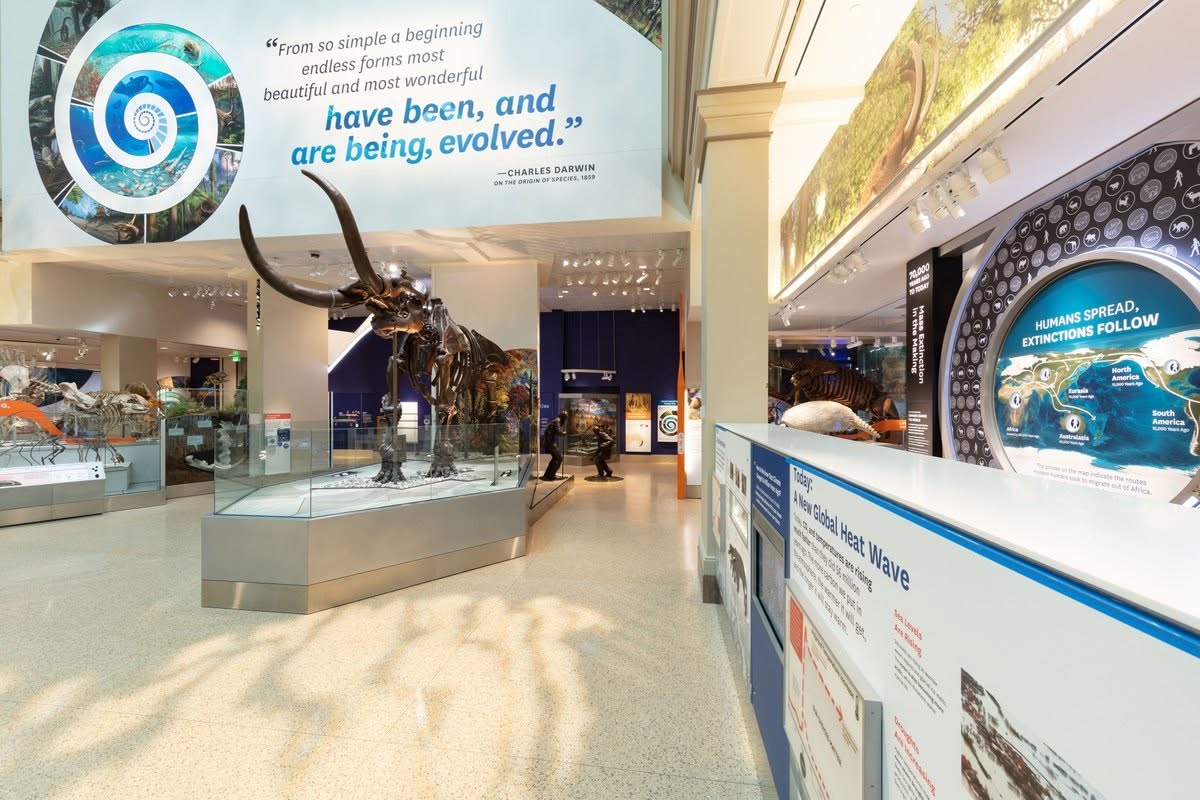
What's inside the San Diego Natural History Museum
The San Diego Natural History Museum — almost universally shortened to "the Nat" by locals — focuses on the natural history of Southern California and the Baja California peninsula, a region with an unusually rich fossil record because of its geology. The paleontology wing is the museum's strongest section, built around real fossils recovered from local excavations rather than only casts and replicas. Beyond fossils, the museum covers regional wildlife, geology, and ongoing conservation research, and it runs a working fossil lab that's sometimes visible to visitors when active preparation work is underway.
The museum also operates a large-format theater showing science and nature films, which functions as a separate add-on rather than being included in every ticket tier by default.
Ticket prices
| Visitor type | Typical price |
|---|---|
| Adult | ~$22 |
| Senior / student / military | ~$18–19 |
| Youth (3–17) | ~$15 |
| Under 3 | Free |
Combination tickets that bundle general admission with a theater film usually cost a few dollars more than admission alone — worth it if you're already planning to spend the better part of a day at the museum, less so for a quick visit.
Free days and discounts
The Natural History Museum participates in Balboa Park's rotating free-Tuesday program on a schedule that changes month to month, and it's also one of the participating museums during San Diego Museum Month each February. See our guide to free museum days in San Diego for the current rotation before you plan a visit around a specific date.
How long to budget
Two to two and a half hours covers the permanent exhibits at a comfortable pace, including the fossil hall, which tends to be the section people linger in longest. Add about 45 minutes if you're catching a film in the giant-screen theater, and check showtimes when you arrive since films run on a fixed schedule rather than continuously.
Advanced tip: The museum occasionally opens its working fossil prep lab to public view through a glass wall — check the day's schedule at the entrance, since it's not staffed and visible every day, and it's one of the only places in the park where you can watch real paleontology work in progress.
Pairing with nearby museums
The Nat sits directly across the Plaza de Balboa from the Fleet Science Center and a short walk from the Museum of Us, making a natural-science-focused pairing easy without much extra walking. For a full plan across Balboa Park's museums, see our Balboa Park museums guide.
Hours and what visitor reviews tend to say
The Nat typically opens daily from around 10am to 5pm, with last entry roughly an hour before close — one of the more visitor-friendly schedules in Balboa Park since it doesn't have a weekly closed day the way some neighboring museums do. Theater showtimes for the giant-screen films run on their own separate schedule within those same open hours, so check the day's film times at the entrance rather than assuming a showing is imminent.
The fossil hall is the most consistently praised section in visitor feedback, and the museum's occasional traveling exhibitions (dinosaurs, ocean life, and similar science-museum staples) get mixed reactions depending on the specific show — some visitors find the added ticket cost worth it, others feel the permanent collection alone justifies the trip. The most repeated frustration isn't about the exhibits but about parking on a Saturday morning, addressed below.
Parking specifics for a Nat visit
The closest free lot sits directly off Village Place, a short walk from the entrance, but it's shared with the Fleet Science Center next door and fills by mid-morning on weekends with school groups and families overlapping. If that lot is full, the larger lots near the Spreckels Organ Pavilion or Inspiration Point are a five-to-eight-minute walk, or the free Balboa Park tram connects from farther satellite lots if walking that distance isn't practical for your group.
Accessibility and when to visit
The museum is fully wheelchair accessible with elevators connecting all exhibit floors, and strollers are welcome throughout, including the fossil hall. Balboa Park parking is free, and the lots nearest the Plaza de Balboa — shared with the Fleet Science Center and Museum of Us — fill fastest on weekend mornings when school groups and families overlap with weekend tourists.
Weekday visits, especially outside of summer break, are noticeably quieter than weekends, when the museum is a default stop for local families. If you're specifically hoping to see the fossil prep lab staffed, calling ahead or checking the museum's daily schedule is worth it, since it isn't guaranteed to be active every single day the museum is open.
How it compares to other natural history museums in the region
Unlike a general national natural history museum built around a broad global collection, the Nat's strength is specificity — its fossil holdings are drawn overwhelmingly from local excavations across San Diego County and Baja California, which means the specimens on display tell a regional geological story rather than a generic overview. For visitors who've been to larger institutions like the ones in Los Angeles or the Smithsonian, the difference is scale but the trade-off is depth: fewer showpiece specimens, but a far more complete regional fossil record than a national museum would ever dedicate space to.
The fossil hall is what people remember — the working prep lab is what makes it worth a second visit.
See exactly where the Nat sits relative to Balboa Park's other museums on our interactive San Diego museums map.
Frequently asked questions
Standard adult admission is around $22, with discounts for seniors, students, and military, and pricing that often bundles a giant-screen film ticket at a small additional cost.
Yes — the paleontology wing with its fossil displays and the museum's regional wildlife exhibits are consistently among the most popular stops in Balboa Park for families with kids roughly ages 5 to 12.
Two to two and a half hours covers the permanent galleries at a normal pace. Add 45 minutes if you're catching a film in the museum's giant-screen theater.
Locally called "the Nat," the museum is best known for its fossil collection documenting Southern California and Baja California's prehistoric past, plus ongoing field research that occasionally puts real working paleontology on public display.